

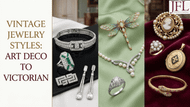
Vintage Jewelry Styles: Art Deco to Victorian
Posted by Pinecone Media on Oct 19th 2026
Vintage Jewelry Styles: Art Deco to Victorian
Vintage jewelry styles span roughly a century of changing taste, from Victorian sentimentality through Edwardian delicacy, Art Nouveau fluidity and Art Deco geometry. Each era left recognisable signatures in cut, setting and metal. Learning those signatures lets anyone date a piece reasonably well without specialist equipment.
At Jewelry 4 Less Atlanta, we sell contemporary diamond and gold jewelry, including engagement rings, chains, pendants, watches, and moissanite pieces. Many customers come in asking about inherited jewelry or seeking modern designs inspired by earlier periods, so we often discuss these distinctions in our showroom.
What Vintage Jewelry Styles Cover
Four main periods account for most pieces people encounter. Victorian runs from the late 1830s to 1901. Edwardian covers roughly 1901 to 1915. Art Nouveau overlaps between about 1890 and 1910. Art Deco follows from around 1920 into the late 1930s.
Strictly, vintage usually means a piece between 20 and 100 years old. Anything older is antique. In practice, people use the terms loosely, so asking a seller what they mean matters more than the tag label.
Why Victorian Pieces Feel Romantic
Victorian jewelry reflects a period obsessed with sentiment and symbolism. Lockets held hair or portraits. Snake motifs represented eternal love, popularised after Prince Albert’s engagement ring to Queen Victoria. Mourning jewelry in jet and black enamel became its own category.
Yellow gold dominates, often in lower karats with ornate engraving. Diamonds appear in closed-back settings with foil behind them to enhance brilliance. Seed pearls, garnets, turquoise and amethyst feature heavily alongside.
What Edwardian Filigree Looks Like
Edwardian jewelry turned delicate and pale. Platinum had become workable, and jewelers used it to create lace-like filigree impossible in gold. Pieces look light, airy and almost white against the skin.
Garland motifs, bows, ribbons and milgrain edging define the period. Diamonds and pearls dominate the stone choices. The overall effect reads elegant and restrained compared with the Victorian pieces that preceded it.
Why Art Nouveau Broke the Rules
Art Nouveau ran alongside Edwardian but pointed in the opposite direction entirely. Designers rejected symmetry in favor of flowing natural forms. Dragonflies, orchids, peacocks and female figures with streaming hair appear constantly.
Enamel work matters more than stone value in this period. Plique à jour enamel, which looks like stained glass, is a signature technique. Pieces were made in smaller numbers, which makes genuine examples relatively scarce.
Which Features Identify Each Vintage Era
Three details date a piece faster than anything else. The diamond cut, the setting construction, and the metal used. Checking all three together gives a far more reliable answer than any single one alone.
How Art Deco Geometry Stands Apart
Art Deco abandoned curves completely. Straight lines, symmetry, bold contrast and geometric repetition define it. Step cuts like emerald, baguette and Asscher suit that aesthetic, and caliber cut coloured stones fit tightly into the design.
Platinum and white gold dominate. Onyx, coral, jade and lapis provide color contrast against white diamonds. The look is architectural rather than romantic, which is exactly why it has aged so well and keeps returning to fashion.
Which Diamond Cuts Date a Piece
Old mine cuts have a cushion shape, large facets and a high crown, cut by hand before electric tools. Old European cuts came next, rounder but still with a small table and visible culet. Modern brilliant cuts arrived around 1919.
A visible culet, a small flat spot at the bottom of the stone, strongly suggests a pre-1920 piece. Modern stones do not have one, so this single detail narrows the date range considerably.
What Metal Choice Reveals
Platinum use effectively begins around 1900. White gold appeared commercially in the 1920s as a cheaper substitute for platinum. Before then, yellow gold was usually lower karat, often 9K or 15K in British pieces.
Hallmarks tell the rest of the story where they survive. British pieces carry date letters that pinpoint the year. American pieces rarely do, so construction details carry more weight there.
How to Buy Vintage Inspired Jewelry Today
Genuine antique pieces need a specialist dealer and proper docum entation. Many buyers want the look without the fragility or sourcing difficulty, which is where vintage-inspired modern pieces come in.
Milgrain detailing, filigree work and halo settings all borrow directly from Edwardian and Art Deco design. Modern manufacturing makes them sturdier and easier to resize than originals, which matters for a ring worn daily.
Why Shop Vintage Inspired Pieces at Jewelry 4 Less Atlanta
Period-inspired settings look very different in person than in photographs, particularly milgrain and filigree detail. We carry lab and mined diamonds across 10K, 14K and 18K gold at Jewelry 4 Less Atlanta, with free shipping, hassle free returns and repairs handled in house.
Conclusion
Vintage jewelry styles become readable once you're familiar with the signatures. Victorian sentiment, Edwardian filigree, Art Nouveau curves, and Art Deco geometry each left clear marks. Check the cut, the setting, and the metal together. Our team can explain what an inherited piece likely is.
FAQ
How can I tell if a diamond is an old cut?
Look for a visible culet, a small flat spot at the bottom of the stone. Modern brilliant cuts do not have one, which suggests a pre-1920 piece.
What is the difference between vintage and antique?
Vintage usually means twenty to a hundred years old, while antique means over a hundred. Sellers use both loosely, so always ask what they actually mean.